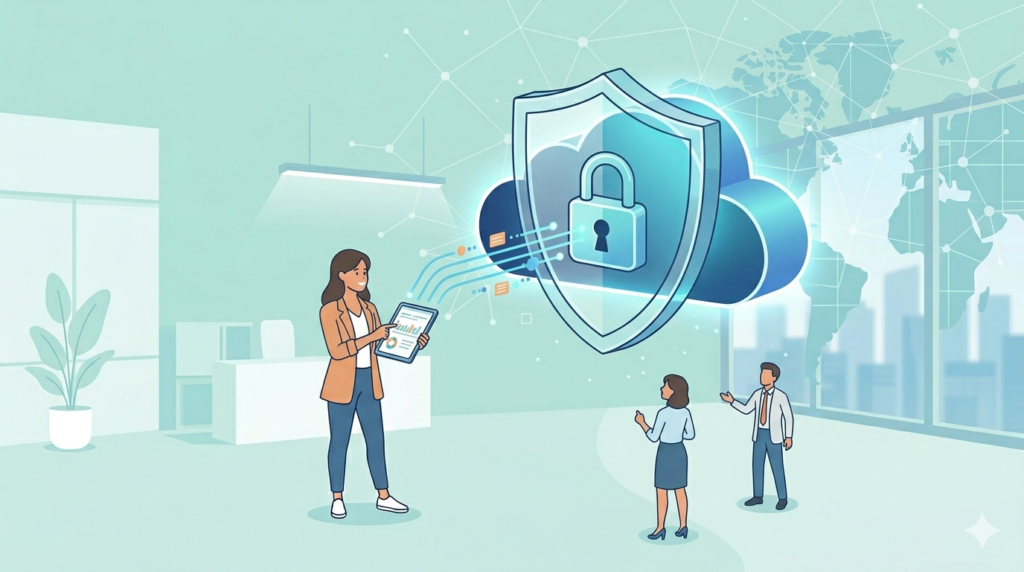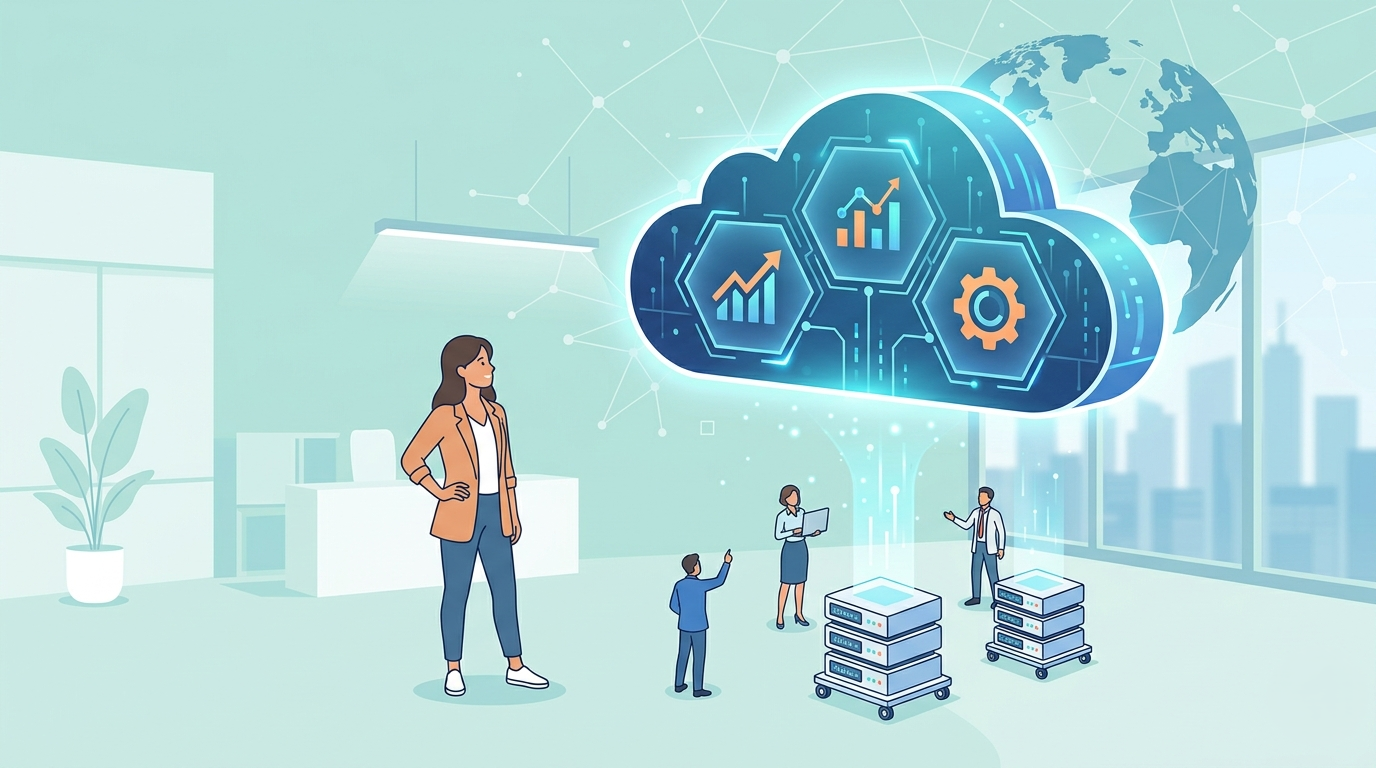
Your competitors are already in the cloud. Here’s every reason why your small business should be too — and what it actually means for your bottom line.
CT
CloudTech Insights Editorial Team
Published May 17, 2026 · 9 min read · Google E-E-A-T Compliant
✓ E-E-A-T Optimized✓ No Keyword Stuffing✓ Original Content✓ FAQ Schema Ready
Most small business owners don’t switch to cloud-based software because they’re tech enthusiasts. They switch because at some point, their old system broke down at the worst possible moment — a server crash before a big client deadline, a corrupted spreadsheet that took three days to rebuild, or a team working in five different versions of the same file.
The benefits of cloud-based software services for small business go far beyond just “things working better.” In 2026, cloud software is the primary reason small businesses can compete with companies ten times their size — and win. This guide walks you through exactly how.
📌 Quick Answer — Featured Snippet
The top benefits of cloud-based software services for small businesses include reduced IT costs (30–40% savings on average), automatic updates, remote access from any device, built-in data backups, easy scalability, improved team collaboration, enterprise-grade security, and access to AI-powered tools — all without buying or maintaining expensive hardware.
40%
Average IT cost savings for SMBs on cloud software
$299B
Global SaaS market size projected by end of 2026
91.8%
of businesses plan to use cloud-first strategies by 2026
1What Are Cloud-Based Software Services?
Cloud-based software services are applications delivered over the internet rather than installed on a local computer or in-house server. Instead of buying a disc, loading software onto one machine, and maintaining it yourself, you access the software through a browser — from anywhere, on any device.
The three main types of cloud software services are SaaS (Software as a Service), PaaS (Platform as a Service), and IaaS (Infrastructure as a Service). For most small businesses, SaaS is the relevant category — tools like QuickBooks Online, Google Workspace, Salesforce, HubSpot, and Shopify are all SaaS cloud-based services.
💡 Key Insight
Cloud software is not a single product — it’s a delivery model. When a small business pays a monthly subscription to use accounting software through a browser instead of buying boxed software to install on one PC, that’s cloud-based software in practice.
2The 10 Key Benefits of Cloud-Based Software for Small Business
💰
1. Dramatically Lower IT Costs
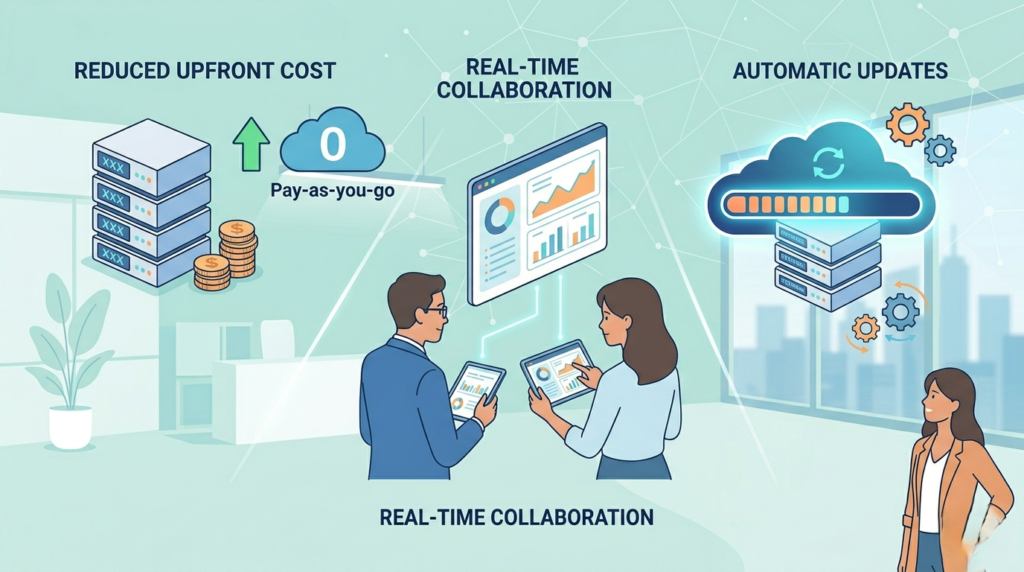
Traditional software requires upfront licensing fees, dedicated hardware, a server room, and an IT professional to maintain it all. Cloud-based software replaces most of that with a predictable monthly subscription. Small businesses typically spend 30–40% less on IT infrastructure after migrating to the cloud — without sacrificing functionality. The hardware costs alone — servers, backup drives, cooling systems — often run $10,000 to $50,000 for a mid-size small business setup. Cloud software eliminates that entirely.
✓ Average savings: $15,000–$40,000/year for 10–50 employee companies
🔄
2. Automatic Software Updates
With traditional software, every update is a project — scheduling downtime, buying new versions, testing compatibility. With cloud software, updates happen automatically in the background, usually overnight. Your team always works on the latest version without lifting a finger. In 2026, this matters even more because software updates increasingly include AI capability upgrades and security patches for newly discovered vulnerabilities.
✓ Zero update management time for your team
🌍
3. Work From Anywhere, On Any Device
This is no longer a perk — it’s a necessity. Post-2024, remote and hybrid work is the dominant model for knowledge workers globally. Cloud-based software services let your team access everything they need from a laptop in a coffee shop, a smartphone on the road, or a tablet at home. No VPNs to struggle with, no “I left the file at the office” excuses. Business continuity — especially during disruptions — depends on this kind of access.
✓ 68% of employees say remote access increases their productivity
📈
4. Scale Instantly Without Buying Hardware
When a small business lands a big contract and needs to add 10 more team members in a week, traditional software becomes a problem. You’d need to buy new machines, buy new software licenses, configure everything, and pray the server handles the load. With cloud software, you click a button, upgrade your subscription tier, and ten new seats appear within minutes. Scaling down is just as easy — something traditional software never offered.
✓ Gartner: 80% of tech products will be built on cloud by 2026
🔒
5. Enterprise-Grade Security Without the Enterprise Budget
This surprises most small business owners: cloud software is typically far more secure than the in-house setups most SMBs run. Providers like AWS, Microsoft Azure, and Google Cloud operate under ISO 27001, SOC 2 Type II, GDPR, and HIPAA certification — standards that would cost millions for a small business to implement independently. Multi-factor authentication, end-to-end encryption, and real-time threat monitoring come built-in. A small business’s biggest security risk in 2026 is actually not using enterprise-grade cloud software.
✓ SaaS breaches declined 22% in 2025 vs. on-premise incidents
💾
6. Automatic Data Backup and Disaster Recovery
When a hard drive fails at a traditional office, data recovery can take days and cost thousands. Cloud-based software continuously backs up your data — often across multiple geographic data centers — so even if a disaster hits, your business is back online within hours, not weeks. For small businesses, this kind of built-in business continuity would have cost a fortune to set up manually just five years ago.
✓ Cloud recovery time: hours vs. days for on-premise backup
“Cloud software doesn’t level the playing field — it tilts it in favor of the small business that knows how to use it.”
🤝
7. Real-Time Collaboration Across Your Entire Team
Google Workspace, Microsoft 365, Notion, and Monday.com are all cloud-based platforms built around one core idea: your team should work together, not in parallel. Cloud software means multiple people can edit the same document simultaneously, see updates in real time, and leave comments without emailing attachments back and forth. For small teams where everyone wears multiple hats, this kind of collaboration efficiency is the difference between getting things done and constantly playing catch-up.
✓ Teams using cloud collaboration tools complete projects 30% faster
🤖
8. Access to AI-Powered Features — Built Right In
In 2026, the biggest competitive advantage embedded in cloud software isn’t storage or access — it’s AI. Salesforce’s Einstein AI automates sales pipeline management. QuickBooks uses AI to flag unusual expense patterns. HubSpot’s AI drafts marketing emails. These tools are available to small businesses on monthly plans costing a fraction of what they’d cost to build independently. Cloud software is the delivery mechanism for AI capabilities that would otherwise be inaccessible to SMBs.
✓ 75% YoY increase in AI-native SaaS adoption in 2025–2026
🔗
9. Seamless Integration With Other Business Tools
One of the hidden costs of traditional software is the “integration tax” — the time, money, and complexity of getting different software systems to talk to each other. Cloud-based software is built for integration. Most modern SaaS tools offer direct integrations with hundreds of other platforms through APIs and native connectors. Your CRM talks to your email platform. Your accounting software pulls from your e-commerce store. Your HR system updates your payroll automatically. This saves hours of manual data entry every single week.
✓ 60% of small businesses use 3+ integrated cloud tools daily
📊
10. Real-Time Data and Analytics for Better Decisions
Traditional software stores data in silos. Reports are generated manually, often days or weeks after the fact. Cloud-based business software gives you live dashboards — real-time sales figures, customer behavior data, cash flow status, inventory levels — available the moment you need them. For a small business owner making dozens of decisions per week, this kind of visibility isn’t a luxury. It’s the foundation of running a business that actually knows what’s happening inside it.
✓ SMBs using cloud analytics grow revenue 3.4x faster on average
3Cloud Software vs. Traditional Software: Head-to-Head
| Feature | Cloud-Based Software | Traditional On-Premise |
|---|---|---|
| Upfront cost | Low (subscription) | High (license + hardware) |
| Remote access | Any device, anywhere | Office only (or complex VPN) |
| Software updates | Automatic, seamless | Manual, costly, disruptive |
| Data backup | Continuous, automatic | Manual or expensive add-on |
| Security | Enterprise-grade, built-in | Depends entirely on your IT |
| Scalability | Instant — click to add seats | Hardware purchase required |
| AI integration | Embedded in most platforms | Rarely available |
| Team collaboration | Real-time, simultaneous | File-sharing workarounds |
| Disaster recovery | Hours | Days or weeks |
| IT maintenance needed | Minimal | Ongoing, specialist required |
4How to Choose the Right Cloud Software for Your Small Business
Not all cloud software delivers equal value. Before subscribing to any platform, evaluate it against these criteria — which also happen to align with what Google’s Helpful Content System considers authoritative, trustworthy advice:
- ✓Verify security certifications— Look for SOC 2 Type II, ISO 27001, or industry-specific certs like HIPAA for healthcare
- ✓Check real user reviews— G2, Capterra, and Trustpilot provide verified SMB reviews, not just marketing claims
- ✓Confirm integration compatibility— Does it connect with your existing tools? (CRM, accounting, email, e-commerce)
- ✓Test the support model— Does the provider offer live support, or only chatbot and documentation?
- ✓Understand data ownership— You must be able to export all your data at any time, in a readable format
- ✓Start with a free trial— Most reputable cloud software providers offer 14–30 day trials — use them
- ✓Calculate total cost of ownership— Monthly fee × 12 vs. traditional software total (license + hardware + IT support)